
 TR
TR  EN
EN Technical Insights
Explore practical engineering guidance on generator selection, power systems, installation and reliable standby power solutions.
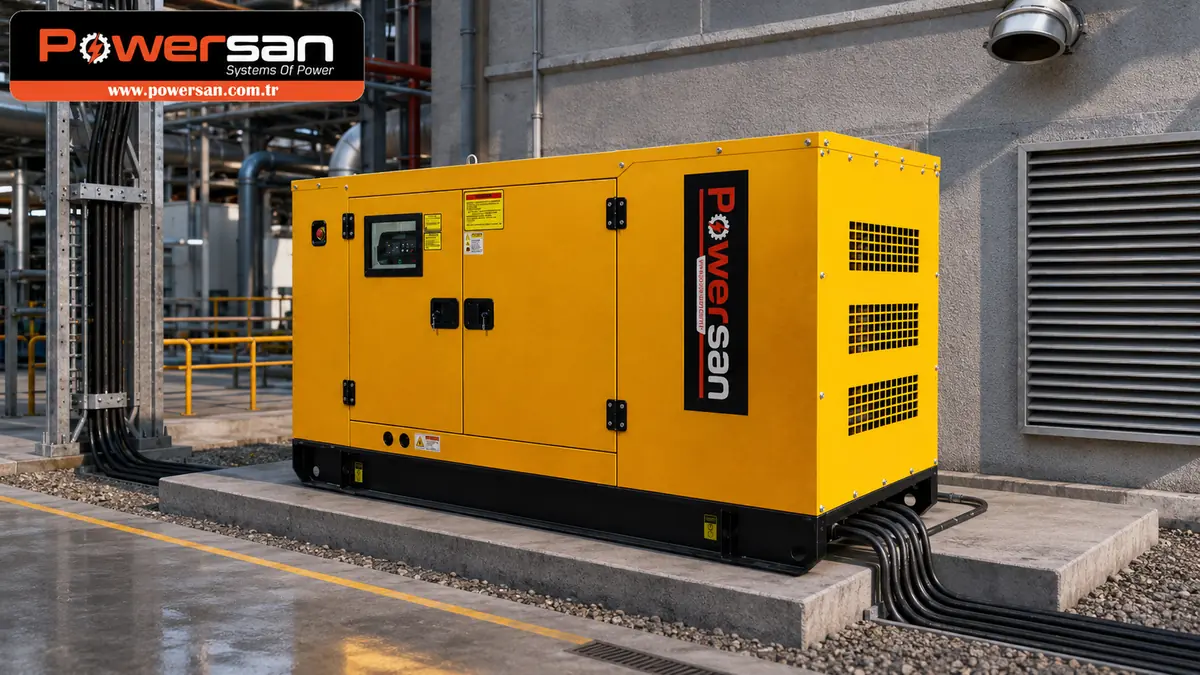
Industrial Generator Selection: Key Engineering Criteria for Reliable Power
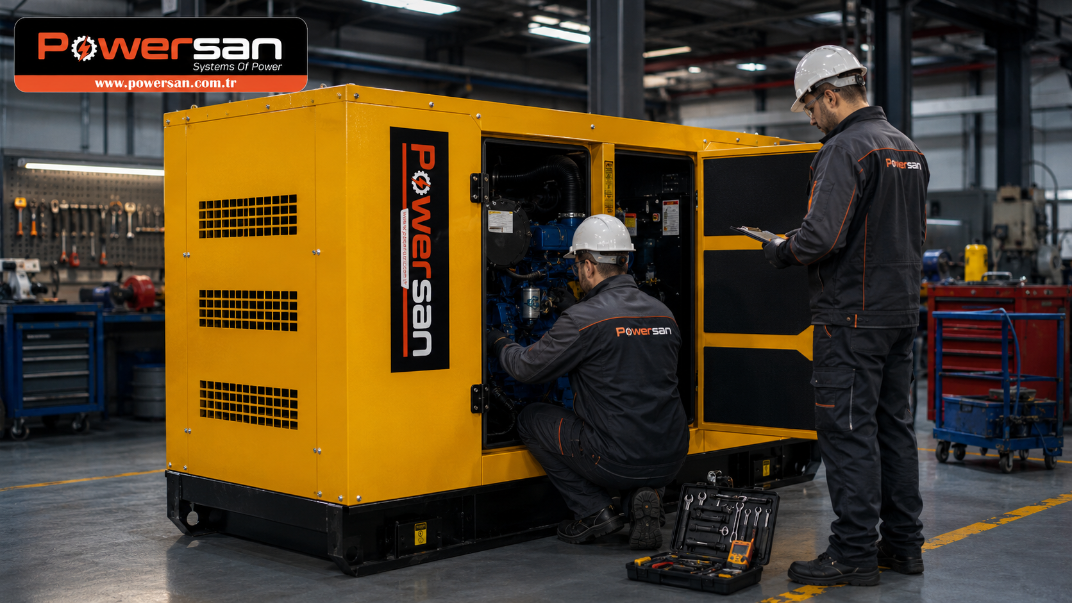
When a production line stops, the loss is rarely limited to a few minutes without power. Interrupted processes, rejected product, restart time and delivery delays can all add to the cost. In a data centre, a power event can affect data integrity; in a hospital, it can affect the continuity of critical equipment. For many facilities, the generator set is therefore not simply standby equipment but an active part of the business-continuity chain.
A common sizing mistake is to total the connected load, add a fixed safety margin and select the generator set from that figure alone. If motor starting behaviour, UPS and drive harmonics, load sequencing, ambient temperature and altitude are ignored, a set that appears adequate on paper may not meet the actual site requirement. The catalogue rating is only one part of the calculation. The way the load behaves matters just as much.
|
At a Glance |
|
Industrial generator selection involves far more than choosing a kVA value from a catalogue. Load profile, motor starting, power quality, duty rating, fuel logistics, installation conditions and maintenance strategy need to be considered together. This guide connects the design calculation with real operating behaviour and explains how poor sizing, inadequate ventilation or weak maintenance practices can translate into avoidable downtime. |
Industrial Generator Selection
Key Engineering Criteria for Reliable Backup Power
1. System Configuration: Open-Type or Canopied?
In an open-type generator set, the engine, alternator, radiator and auxiliary equipment remain accessible on the base frame. Where the generator room has been properly designed, this arrangement can provide good service access for filter replacement, belt inspection and alternator connections. It also offers greater flexibility for project-specific silencers, ventilation ductwork or remote-radiator arrangements on larger installations.
A canopied generator set places the engine-alternator assembly inside an enclosure intended to limit noise and provide environmental protection. This can be practical for construction sites, logistics facilities, outdoor plant areas or sites without a dedicated generator room. “Canopied”, however, does not guarantee the same acoustic performance or environmental resistance in every product. Enclosure design, corrosion protection, air inlet and discharge geometry, silencer arrangement, site conditions and the distance used for sound measurements all need to be considered.
|
Field Note Positioning a canopied generator too close to a wall can allow hot radiator discharge air to recirculate into the cooling-air inlet. The set may appear normal at light load, yet become unable to reject enough heat as the load rises, eventually triggering a high coolant-temperature shutdown. The problem is not always engine capacity; airflow design can be the limiting factor. |
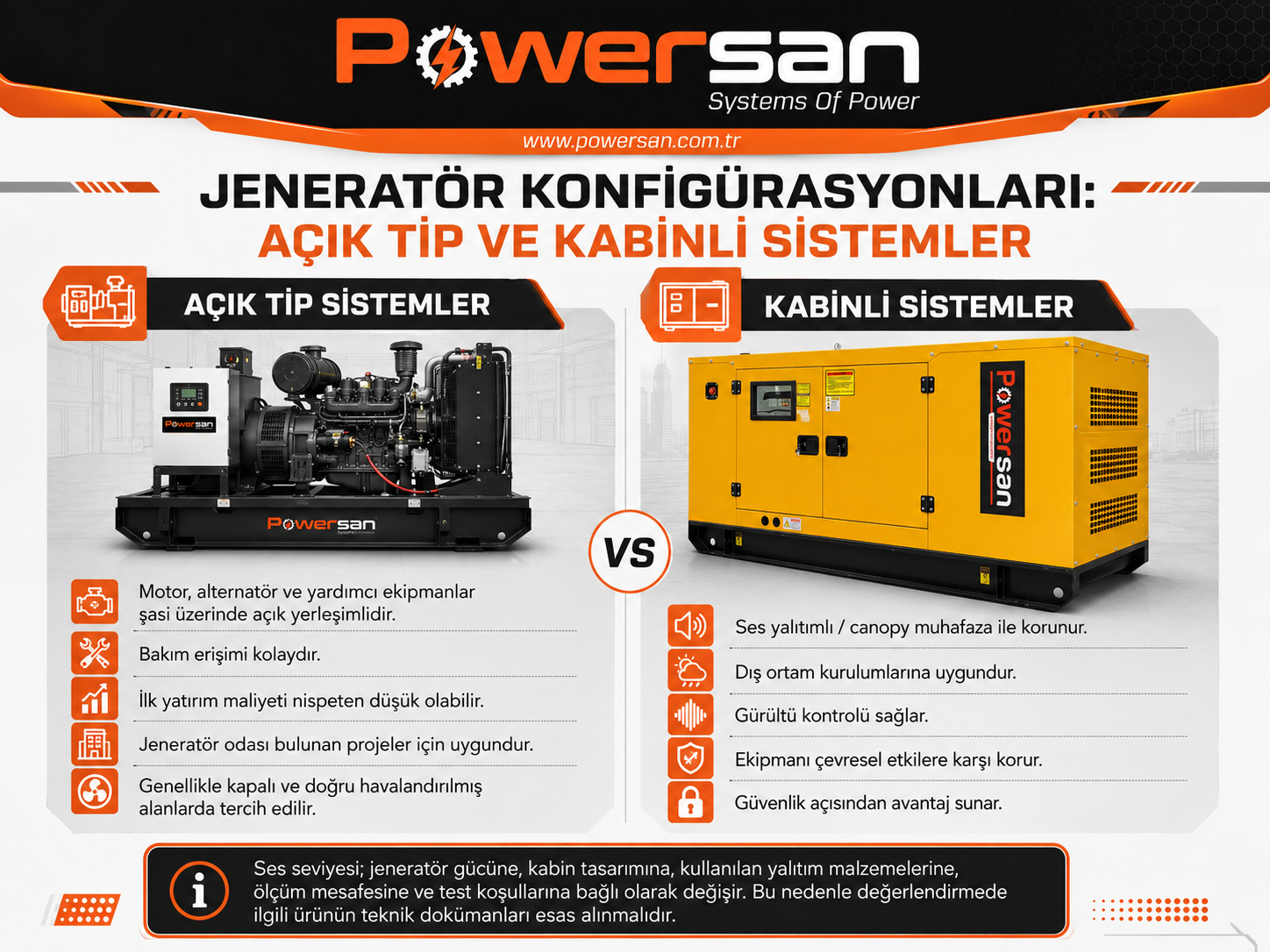
Maintenance access, environmental conditions and acoustic requirements should be considered together when choosing between open-type and canopied configurations.
2. Power Sizing: kW, kVA and Actual Load Behaviour
kW represents active power, while kVA represents apparent power. Many three-phase industrial generator sets are rated at a reference power factor of 0.8, with the relationship kW = kVA × power factor. That relationship is useful as an initial check, but final sizing must also consider the actual power factor, efficiency, harmonic content and connection sequence of the loads.
A facility may have 600 kW of connected load without requiring a 600 kW generator if all loads do not operate at the same time. The reverse can also occur. A system with a much lower steady-state demand may still require additional generator capacity, or a different starting strategy, if a large motor is started direct-on-line and creates a severe transient voltage or frequency dip. The load schedule should therefore distinguish continuous, intermittent, motor, electronic and critical loads.
Motor nameplate kW alone is not enough. Direct-on-line, star-delta, soft-starter and variable-frequency-drive starting methods can produce very different starting kVA and transient behaviour for the same motor. UPS systems, rectifiers, variable-speed drives and some welding equipment can also draw non-sinusoidal current, creating additional alternator heating and voltage waveform distortion. In these applications, alternator sizing, reactances, short-circuit behaviour and the AVR/excitation system need to be evaluated together.
|
Practical Scenario In a crushing plant, sequencing conveyor motors can keep the transient demand under control. If the control system starts all motors at once, the generator may experience a voltage and frequency dip severe enough for contactors to drop out, even though each motor could operate normally once running. The right answer is not always a larger generator; sometimes it is better load sequencing. |
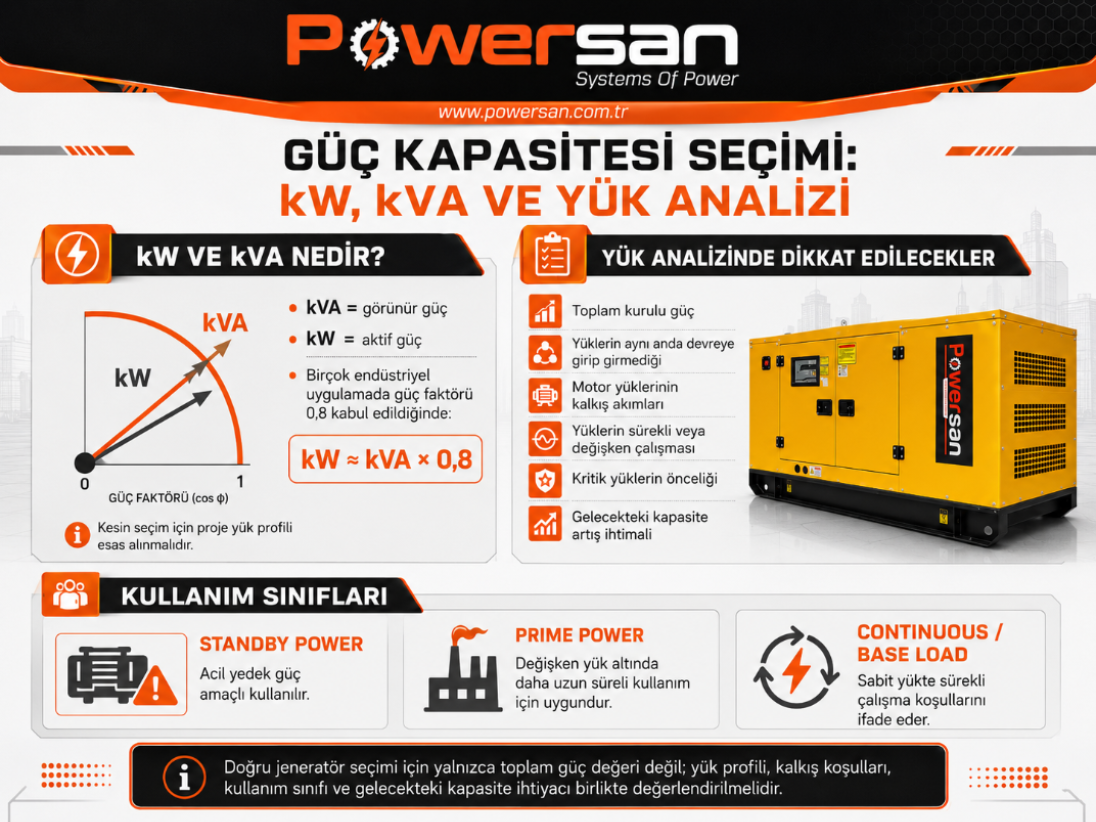
Generator sizing should consider active power, apparent power, power factor and the way loads are connected to the set.
3. Duty Ratings and Transient Load Acceptance
Two generator sets with the same kVA value can be rated for different operating duties. ISO 8528-1 and manufacturer data sheets distinguish ratings such as Emergency Standby Power (ESP), Prime Rated Power (PRP) and Continuous Operating Power (COP) for different service conditions. ESP is intended for standby service during a reliable utility outage, PRP for long-duration operation with variable load, and COP for defined continuous operating conditions. Permitted operating hours, average load and overload capability must be checked against the exact rating definition and the manufacturer’s data sheet.
Transient performance is especially important in data centres. A UPS may bridge the initial interruption, but the generator set still needs to reach stable voltage and frequency quickly, accept the specified block loads and, in a parallel architecture, synchronise reliably. Cummins, for example, uses a manufacturer-specific Data Center Continuous (DCC) rating on certain data-centre generator products. Data-centre ratings from different manufacturers should not be assumed to represent identical conditions; the published load profile, duration and application limits must be checked for the selected product.
Load acceptance depends on more than engine power. Turbocharger and fuel-system response, rotating inertia, alternator electromagnetic characteristics, excitation system, AVR response and controller settings all influence the transient result. On critical projects, single-step load acceptance, voltage and frequency deviation, and recovery time should be checked against manufacturer test data and the project acceptance criteria.
|
Engineering Note Oversizing a generator so far that it spends most of its operating time at very low load is not a sound way to provide for future growth. Extended low-load operation can reduce diesel-engine operating temperatures and contribute to deposits, soot accumulation and wet stacking. The acceptable minimum load is engine- and manufacturer-specific. Where the project justifies it, a parallel-generator architecture can provide a more flexible route to future capacity. |
4. Fuel Selection, Emissions and Emerging Solutions
Diesel generator sets remain widely used for industrial standby power because fuel can be stored on site and the technology is available across a broad power range with strong transient capability. Fuel quality and storage conditions are as important as tank capacity. Water, sediment or microbial contamination in stored fuel can restrict filters and impair fuel-system performance.
Natural-gas and biogas generator sets can suit longer-duration operating scenarios where the gas supply is dependable. A pipeline supply can reduce the need to store large quantities of liquid fuel on site. Gas pressure and quality, continuity of gas supply during a utility outage, engine transient response and the applicable emissions requirements still need to be confirmed at the design stage. An emissions advantage should not be assumed from fuel type alone.
Exhaust-emissions requirements can affect engine selection, aftertreatment, maintenance planning and installation space. On systems fitted with SCR, DEF/AdBlue consumption and logistics need to be planned. DPF-equipped systems require attention to regeneration conditions and exhaust temperature, while oxidation catalysts and other aftertreatment components have their own manufacturer-defined service requirements. Local regulations and the engine’s certified emissions level must be checked together.
Renewable paraffinic fuels such as HVO can be an option for reducing lifecycle greenhouse-gas emissions where an appropriate supply chain is available; this does not mean that tailpipe CO₂ falls by the same proportion. Before use, the engine or generator-set manufacturer’s approval, accepted fuel specification and any model-specific derate or service requirements should be confirmed. Hybrid systems that combine solar or wind generation, battery storage and a generator can reduce generator running hours, but the energy-management strategy, battery charging logic and acceptable engine load range need to be engineered carefully if the expected operating benefit is to be achieved.
5. Alternator, AVR and Power Quality
The engine produces mechanical power; the alternator converts that power into electrical energy. Selecting a generator by engine brand while treating the alternator as secondary is therefore a serious omission. Insulation class, enclosure protection, winding design, temperature-rise limit, short-circuit behaviour and capability with non-linear loads should all suit the application.
The AVR monitors alternator output voltage and regulates the excitation system. When load changes suddenly, voltage can deviate for a short period; the AVR and excitation system help restore it towards the target value. In facilities with sensitive electronic loads, this transient behaviour can be as important as steady-state voltage regulation. PMG-fed AVRs or auxiliary-winding excitation can, in suitable alternator designs, help isolate the excitation supply from the effects of non-linear loads and support motor starting. The correct arrangement depends on the load profile and manufacturer data.
UPS systems and variable-speed drives can draw non-sinusoidal current. Current harmonics can increase alternator heating, raise neutral-current levels and distort the voltage waveform. The solution may involve a larger alternator, a design with suitable reactance characteristics or generator-compatibility data from the load manufacturer. There is no single universal “harmonic load factor” that can be applied to every non-linear load; the application should be assessed from its harmonic current spectrum and kVA characteristics.
|
Field Note If a generator is stable at no load but produces a voltage alarm when a UPS is connected, the AVR is not automatically at fault. The UPS input rectifier, alternator short-circuit/reactance characteristics and AVR settings may be interacting poorly. Measuring the waveform and transient response with suitable power-quality equipment is a better first step than replacing components by assumption. |
6. Control Systems, ATS and Synchronisation
A generator controller is more than a start/stop display. Depending on the controller and application, it can monitor oil pressure, coolant temperature, speed, battery voltage, phase voltages, current, frequency, power factor, active and reactive power; manage protective thresholds; and store event records. During fault analysis, the sequence of events leading up to the final alarm can be as valuable as the alarm itself.
An Automatic Transfer Switch (ATS) selects the appropriate source and transfers the load between utility power and the generator. When utility power fails, the generator receives a start command. Transfer takes place after the engine reaches rated speed and generator voltage and frequency are within the accepted range. When utility power returns, the source is allowed to stabilise before retransfer; the generator then completes its configured cool-down period before stopping. Timing settings should match the facility process and equipment requirements.
Where multiple generator sets operate in parallel, voltage, frequency, phase sequence and phase angle must be matched within the control system’s permitted tolerances before closing onto the bus. Once synchronised, active-load sharing is managed through the engine speed/fuelling control and reactive-load sharing through the excitation/AVR system. Incorrect current-transformer polarity, phase-sequence errors or incompatible control settings can lead to reverse power, circulating reactive current and poor load sharing.
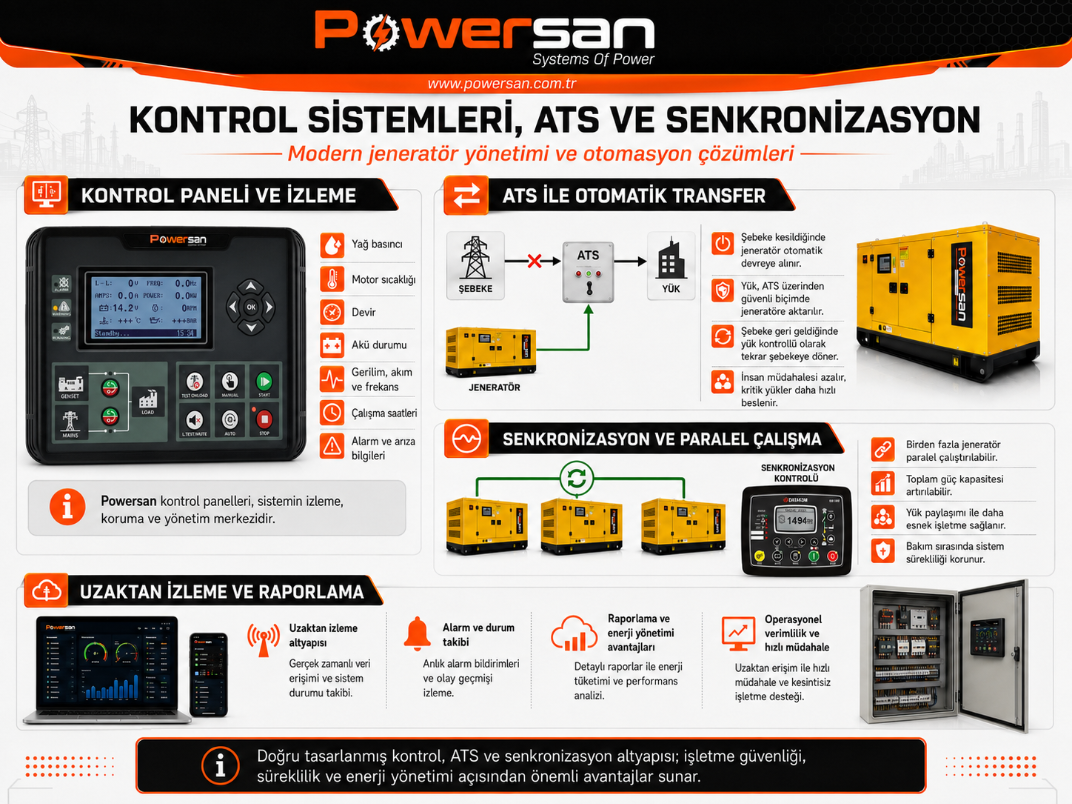
Generator control, ATS, synchronisation and remote-monitoring layers form part of the same power-management architecture.
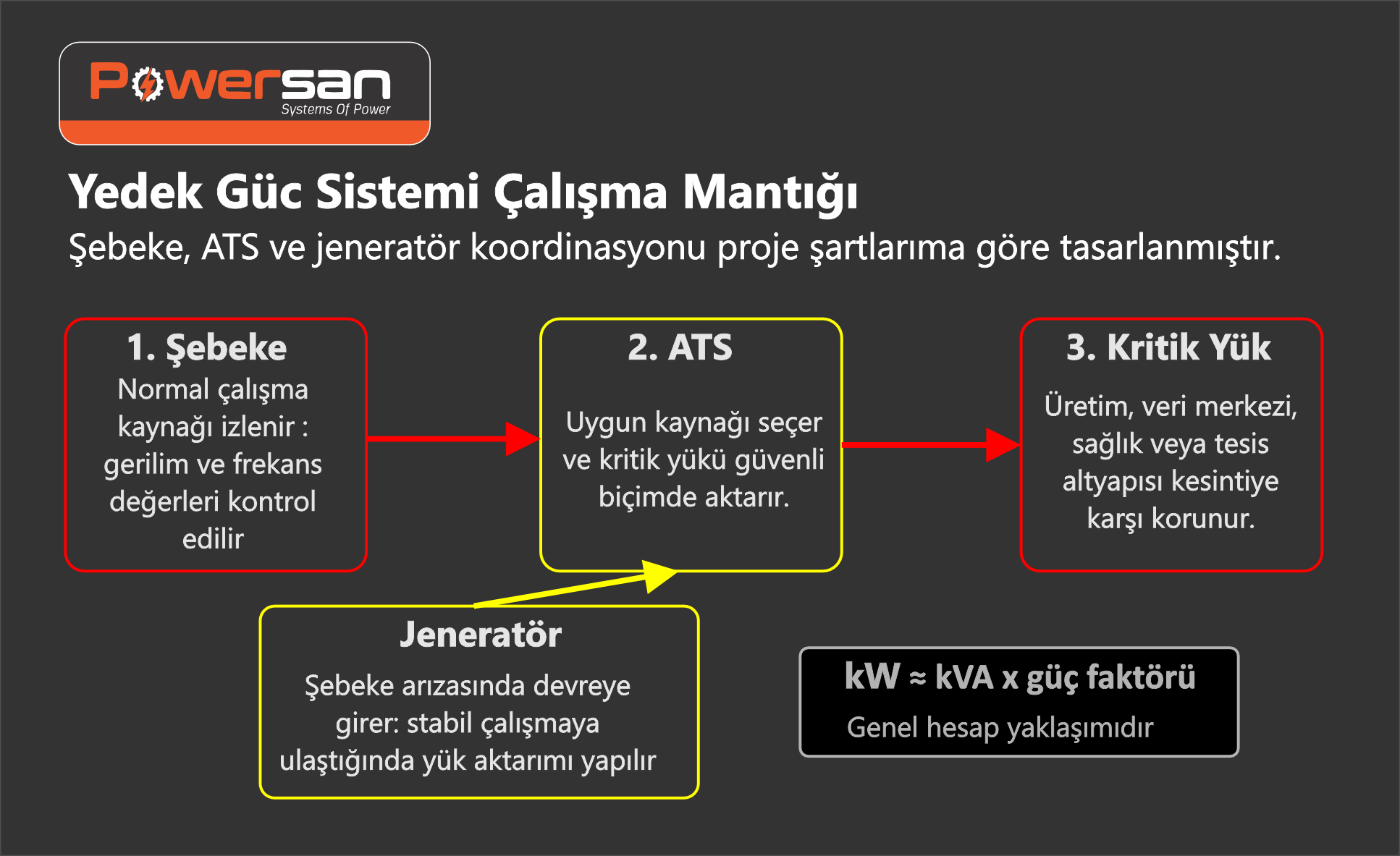
The transfer logic between utility power, ATS, generator and critical load should be engineered for the project requirements.
7. Installation: Where Generator Performance Is Won or Lost
A correctly selected generator can still become unreliable through poor installation. Foundation capacity, vibration-isolator arrangement, service clearances, cable routing, exhaust back pressure, fuel piping and ventilation design need to be treated as one system. The generator room should be engineered while the equipment is being selected, not after it has been placed on site.
A large wall opening alone does not guarantee that radiator discharge air will leave the room effectively. Inlet area, duct losses, louvre and acoustic-attenuator resistance, prevailing wind direction and other room heat sources should be considered. Excessive bends, inadequate pipe diameter or an unsuitable exhaust run can push engine exhaust back pressure beyond the permitted limit, causing performance loss and high exhaust temperature. The engine manufacturer’s allowable back-pressure limit should govern the design.
Available engine and alternator output can fall as altitude and ambient temperature increase. These derating values should come from manufacturer data rather than estimates. A set that is adequate at sea level may not carry the same load with the same performance at a high-altitude, high-temperature site. Dust, humidity, salt and corrosive or chemical atmospheres may also require different filtration, coatings or enclosure protection.
Earthing and neutral arrangements must be designed together with the protection system. The choice between three- and four-pole transfer switching, whether the neutral is switched, generator-star-point earthing and residual-current/protection arrangements depends on the site distribution system. This cannot safely be copied from a generic diagram; the project engineer needs to evaluate the earthing system, fault levels and protection coordination together.
|
Practical Check Can every service door open fully? If a radiator or alternator has to be removed, is there a practical route to take it out of the room? Does access to a fuel filter require a technician to work beneath a hot exhaust line? Questions that are ignored on the drawing can become expensive and unsafe problems on maintenance day. |
8. Commissioning, Testing and Planned Maintenance
Commissioning is not simply starting the engine and confirming nominal output voltage. Phase sequence, protective settings, ATS timings, emergency stop, fuel and cooling-system checks, battery charging, remote signals and electrical/mechanical values under load should be verified. Where required by the project acceptance plan or applicable standards, the installation should be tested progressively with facility load or a suitable load bank and the results recorded.
Running a generator at no load does not, by itself, verify full operating performance. The engine may run, but the alternator, fuel system, cooling system and exhaust system do not experience real load conditions. If facility load cannot be used safely, a load-bank test can be performed in accordance with the manufacturer and project procedures. Voltage, frequency, load, oil pressure, coolant temperature, relevant exhaust values and alarm/event records should be monitored during the test.
The starting battery is a critical component whose available capacity reduces with age and condition. A charger may appear normal while a weak battery still suffers excessive voltage drop during cranking. Fuel and air filters, engine oil, coolant, belts, hoses and electrical connections should be maintained according to the manufacturer’s running-hour and calendar intervals. Heavy dust, high ambient temperature, low utilisation or long standby periods may require the maintenance approach to be adjusted.
|
Example Fault Scenario A generator that has been exercised only at no load may still experience low fuel pressure when a significant load is applied, even with a full tank. One possible cause is sediment or contamination accumulated during storage restricting the filter when fuel flow increases. In that situation, tank level alone is not enough: fuel condition, filter restriction, supply pressure and operation under load should all be checked. |
9. Pre-Project Checklist
| Check | Key question to answer |
|---|---|
| Load profile | Which loads are continuous and which are intermittent? What is the largest single-step load? |
| Motor starting | How are the motors started, and in what sequence? |
| Electronic loads | Are harmonic and generator-compatibility data available for UPS systems, drives, rectifiers or welding equipment? |
| Duty rating | Is the set for emergency standby only, or will it operate as prime/long-duration power? |
| Site conditions | What are the altitude, temperature, humidity, dust, salt/corrosion and noise limits? |
| Fuel logistics | What runtime is required, how will the tank be sized and filled, and how will fuel quality be monitored? |
| Transfer and controls | Are ATS timings, remote monitoring, BMS/SCADA interfaces and alarm scenarios defined? |
| Maintenance access | Is there safe access to filters, batteries, radiator, alternator and connection points? |
| Test plan | How will commissioning and periodic load testing be carried out, what are the acceptance criteria, and what records will be retained? |
The Operational Impact of Correct Engineering
The right generator is not simply one that can carry the nominal load. It should start within the planned outage sequence, remain within acceptable limits during transient load changes, operate correctly with the site protection and transfer architecture, and allow the maintenance team to reach the equipment safely.
Open-type or canopied configuration, duty rating, fuel, alternator, control system, ATS or synchronisation requirements, site installation and maintenance strategy are not independent decisions. A reliable generator system emerges when these factors are engineered together around the actual load profile and the operating conditions of the project.
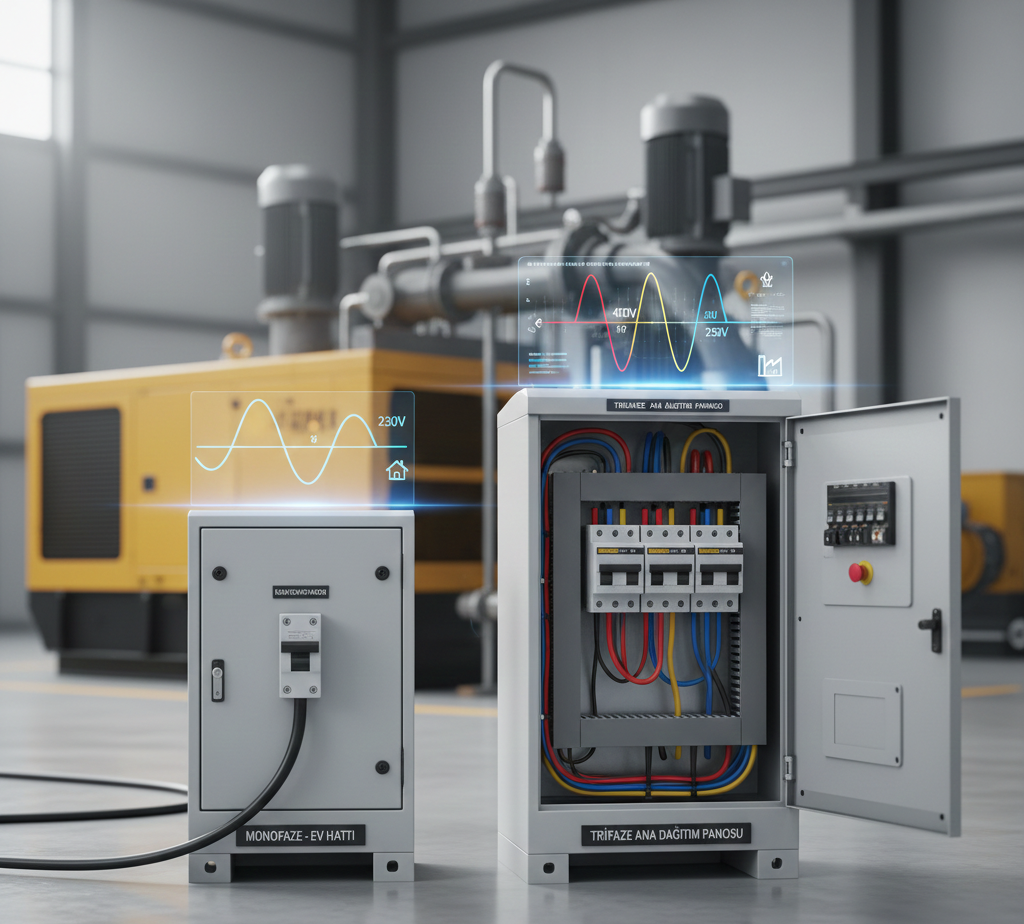
Single-Phase vs Three-Phase Systems: Technical Differences and Generator Selection
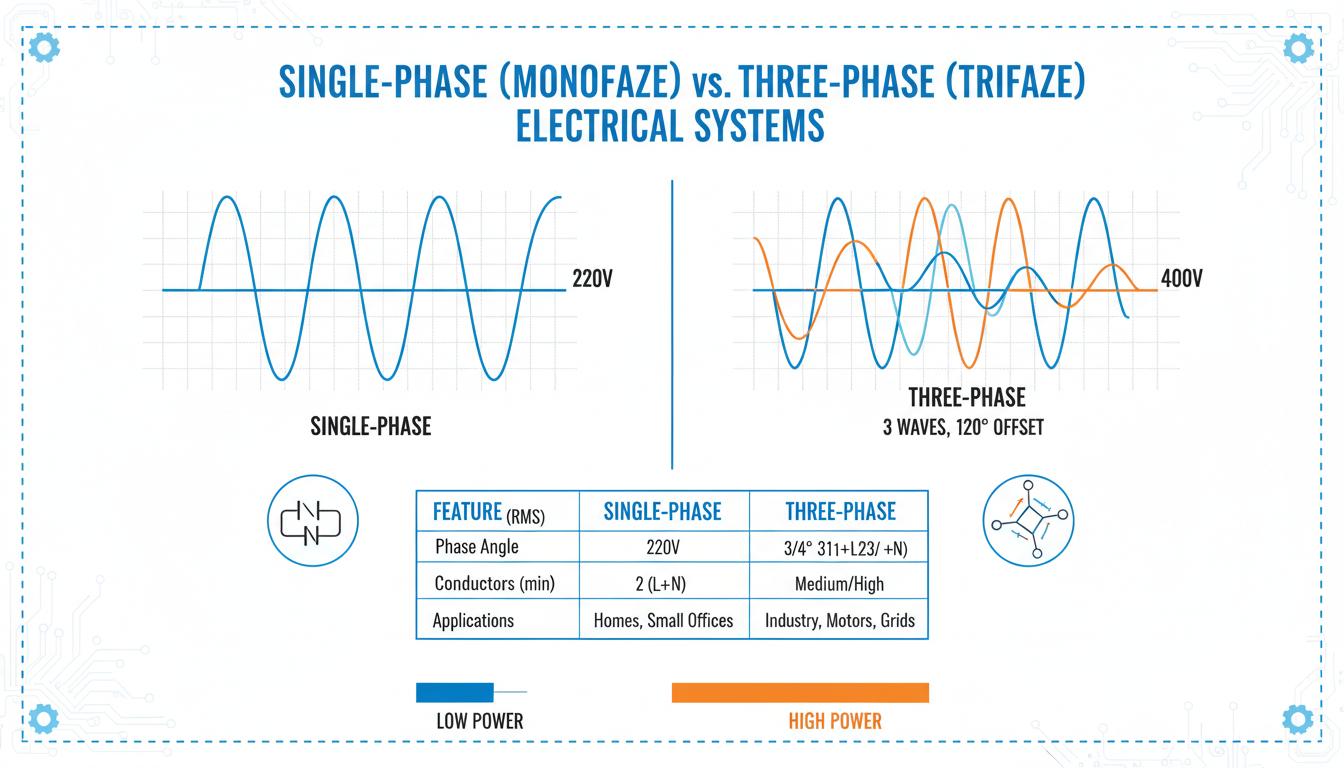
The difference between single-phase and three-phase power goes well beyond the number of conductors in the installation. The connected load, motor requirements, available distribution system and the equipment that a generator must supply all influence the correct phase configuration. Single-phase power is often sufficient for smaller loads, while three-phase systems are better suited to installations with larger motors and higher power demand.
1. The Basic Difference Between Single-Phase and Three-Phase Power
In a common 230/400 V low-voltage system, single-phase loads are supplied at 230 V between phase and neutral. A three-phase system provides three phases, with 400 V available between phases. The three AC voltage waveforms are displaced from one another by 120 electrical degrees.
A three-phase installation may be designed with or without a neutral conductor. Where 230 V single-phase loads must also be supplied from a 230/400 V distribution system, a neutral is normally provided. Other three-phase applications may use a different connection arrangement.
| Technical Feature | Single-Phase | Three-Phase |
|---|---|---|
| Phase Configuration | One phase; commonly used with neutral | Three phases; neutral depends on the system configuration |
| Common Phase-to-Neutral Voltage | 230 V | 230 V in a 230/400 V system with neutral |
| Common Phase-to-Phase Voltage | Not applicable | 400 V |
| Phase Relationship | One AC phase | 120° between phases |
| Typical Applications | Residential, light commercial and portable loads | Industrial plants, larger commercial facilities, motors and machinery |
2. How a Single-Phase System Works
A single-phase supply uses one alternating-voltage phase. In a phase-to-neutral circuit, current passes through the load and returns through the neutral conductor. Lighting, socket circuits, office equipment and many domestic appliances operate comfortably from this type of supply.
There is no universal kW limit that can be applied to every single-phase installation. Available capacity depends on the service connection, protective devices, conductor size, allowable current and the design of the electrical installation. For that reason, a fixed statement such as “single-phase power cannot be used above a certain kW value” is not a reliable basis for system design.
3. How a Three-Phase System Works
A three-phase supply has three alternating voltages separated by 120 electrical degrees. The arrangement allows larger loads to be supplied and gives designers the ability to distribute the total demand across three phases.
This is why three-phase motors are common in pumps, compressors, fans, production machinery and larger HVAC systems. The important point is not simply that three-phase power can serve larger loads. The distribution system must also be designed so that the connected equipment and phase loading are appropriate for the installation.
How Can the Phase Configuration Be Identified?
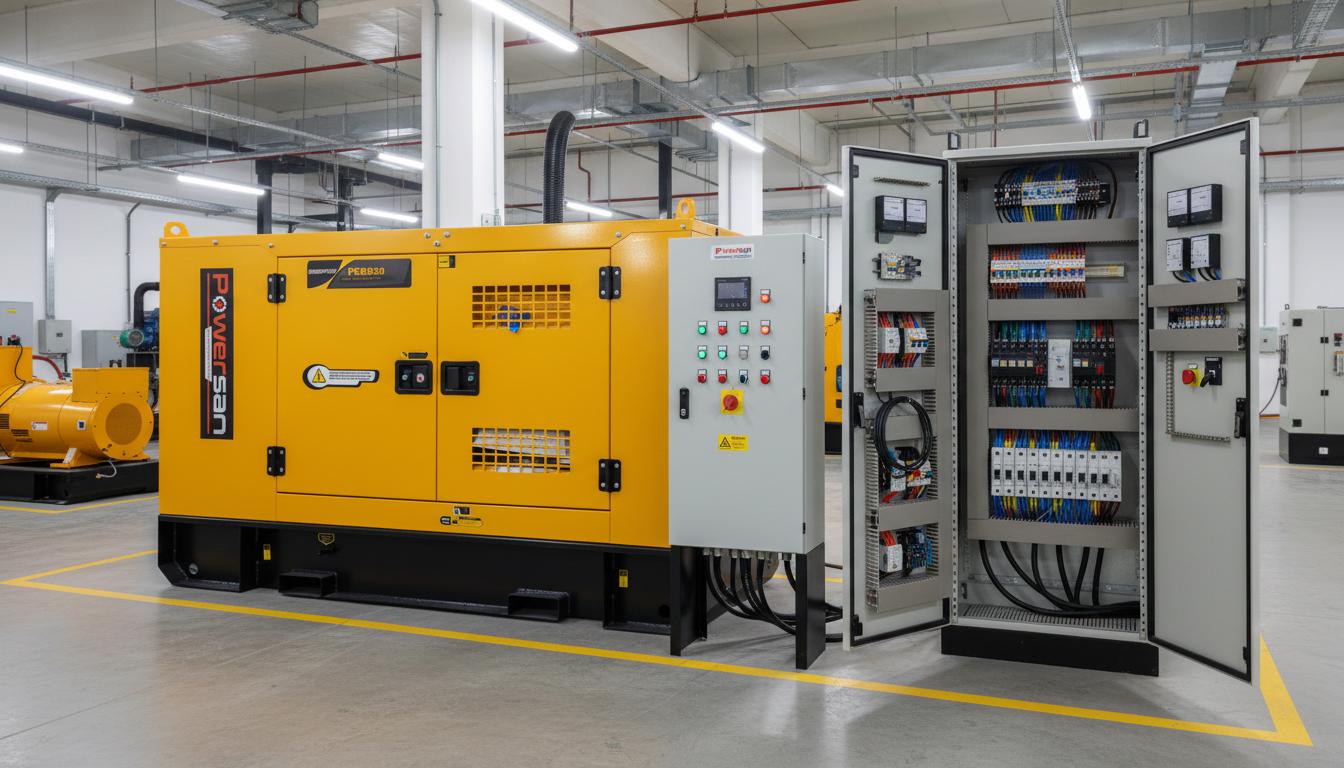
The main switch, protective devices and conductor arrangement in a distribution board can provide an initial indication of the supply type. They should not be treated as the only evidence. Equipment labels and supply information should be checked, and where necessary the voltages should be measured by a qualified electrical technician using suitable test equipment.
4. Why Phase Configuration Matters in Generator Selection
Generator selection cannot be based on total kW or kVA alone. The phase configuration of the loads, motor starting behaviour, power factor and the sequence in which loads are connected all affect the demands placed on the generator set.
Motors, pumps and compressors can impose a very different electrical demand while starting than they do once they are running normally. If this transient demand is ignored during generator sizing, starting a large motor may produce an unacceptable temporary drop in generator voltage or frequency.
When Does a Single-Phase Generator Make Sense?
Where all or most of the connected equipment consists of 230 V single-phase loads, a correctly sized single-phase generator can be the simpler choice. Portable applications, smaller businesses, some residential standby systems and temporary site power are typical examples.
When Is a Three-Phase Generator Required?
A three-phase generator is appropriate where the installation contains motors, production machinery or other equipment that requires a 400 V three-phase supply. Factories, construction sites, pumping systems and larger commercial installations commonly fall into this category.
Using a three-phase generator does not mean that every connected load must be three-phase. If the alternator connection and neutral arrangement allow it, single-phase loads can also be supplied.
5. Balancing Single-Phase Loads on a Three-Phase Generator
When single-phase loads are connected to a three-phase generator, placing most of them on one phase is poor practice. The loads should be distributed as evenly as practical across L1, L2 and L3.
If one phase carries substantially more load than the others, the generator's full capacity may not be usable and phase-voltage imbalance can increase. For this reason, a proper load schedule should show not only the total connected load but also how much demand is placed on each individual phase.
In a facility with many single-phase lighting and socket circuits, distributing those circuits between the three phases helps maintain a better-balanced generator load.
6. Motors and Starting Loads
Motor loads deserve separate attention in an industrial generator project. The normal running power shown on the motor nameplate does not tell the whole story. A motor started directly across the line can draw a high current for a short period, producing a temporary voltage dip at the generator.
Motor rating, starting method, mechanical inertia, other loads already connected to the generator and the acceptable voltage dip should be considered together. Projects with large motors are better assessed with generator-sizing software or a detailed engineering calculation rather than a simple addition of nameplate kW values.
7. Comparing Single-Phase and Three-Phase Systems
| System | Where It Works Well | Points to Consider |
|---|---|---|
| Single-Phase | Simpler infrastructure, compatibility with common 230 V equipment, practical for smaller loads | Cannot directly supply equipment requiring a three-phase source; available capacity depends on the installation |
| Three-Phase | Suitable for higher-power equipment, three-phase motors and distribution of loads between phases | Phase sequence, load balance, neutral arrangement, protection and distribution design must be correct |
8. Is Voltage Drop Determined by the Number of Phases?
No. Voltage drop cannot be assessed simply by deciding that one system is single-phase and the other is three-phase. Circuit length, current, conductor cross-section, conductor characteristics, system voltage and load power factor all influence the result.
Three-phase distribution can offer practical advantages when larger amounts of power must be transmitted at suitable voltage and current levels, but conductor sizing and allowable voltage drop still need to be calculated for the actual installation.
9. Frequently Asked Questions
Can a home have a three-phase electricity supply?
Yes. A residential property can have a three-phase connection where the local supply arrangement permits it. The need depends on the connected load. EV charging equipment, large heat pumps, lifts or workshop machinery are examples of loads that may make a three-phase connection useful.
Can 230 V single-phase equipment run from a three-phase system?
Yes. In a suitable 230/400 V three-phase system with a neutral conductor, a 230 V single-phase load can be connected between one phase and neutral. Single-phase loads should be distributed between the available phases rather than concentrated on one phase.
Is a three-phase generator always better than a single-phase generator?
No. The correct generator is the one that matches the actual load. In a small installation containing only single-phase equipment, choosing a three-phase generator does not automatically provide a technical or economic advantage. Where three-phase motors and higher-power machinery are present, the three-phase configuration becomes the appropriate choice.
Choosing the Right Phase Configuration
The decision should start with the load list, not the generator catalogue. Identify which equipment is single-phase or three-phase, how motors start, which loads operate at the same time and how much future capacity is likely to be required. The existing electrical distribution system then has to be considered alongside those requirements.
For Powersan generator projects, load characteristics and site conditions are evaluated together when selecting generator capacity, voltage and phase configuration. In installations with a mixture of single-phase and three-phase loads, phase distribution is part of the sizing work rather than an adjustment left until commissioning.
```
What to Consider When Choosing a Generator
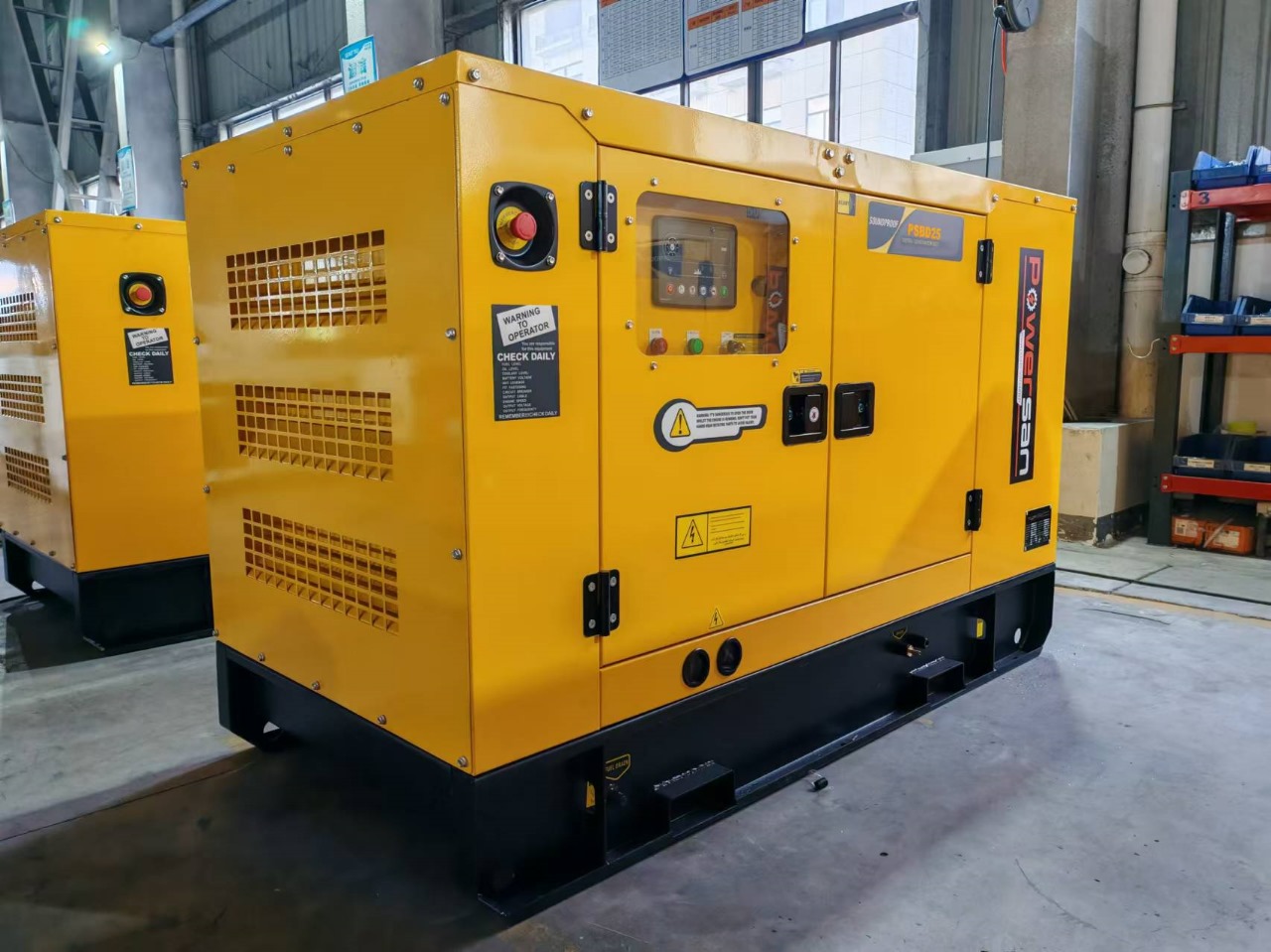
Choosing the right generator requires more than simply selecting a unit with a high power rating. The generator must be matched to the electrical load, operating conditions and intended application. A properly selected generator can provide reliable power while avoiding unnecessary oversizing or performance problems.
Determine the Required Power Capacity
The first step is to identify the loads that the generator will need to supply. This includes the normal running demand as well as the additional starting power required by equipment such as electric motors, pumps, compressors and HVAC systems.
For this reason, generator sizing should not be based only on the sum of equipment nameplate wattages. Starting currents, simultaneous loads, load characteristics and future capacity requirements should also be considered when determining the appropriate generator rating.
Choose the Appropriate Fuel Type
Generator sets are available with different fuel options, including diesel, gasoline, LPG and natural gas, depending on the application and power range.
Portable gasoline-powered generators may be suitable for smaller or temporary applications, while diesel generator sets are widely used for commercial and industrial standby or prime-power requirements. Gas-fuelled generator systems can also be considered where an appropriate and reliable fuel supply is available.
The most suitable fuel option depends on factors such as operating duration, required power, fuel availability, installation conditions and maintenance requirements.
Consider Portability and Installation Conditions
Portability is important when the generator needs to be moved between locations or used for temporary applications. Compact portable generators are generally easier to transport, while larger generator sets are normally installed as fixed or semi-permanent power systems.
For stationary installations, sufficient attention should also be given to ventilation, exhaust routing, access for maintenance, fuel storage and the available installation area.
Evaluate Noise Requirements
Noise level can be an important selection criterion, particularly in residential areas, hospitals, hotels, commercial buildings and other noise-sensitive environments. Generator noise is typically expressed in decibels (dB), although the measurement distance and operating conditions must also be considered when comparing specifications.
Where lower noise levels are required, a properly designed acoustic enclosure and suitable installation layout can significantly improve the overall acoustic performance of the generator system.
Plan for Fuel, Maintenance and Operating Requirements
Fuel capacity, expected operating hours and routine maintenance requirements should also be considered before selecting a generator. Engine oil, filters, cooling-system components and other service items require periodic inspection or replacement according to the manufacturer's maintenance schedule.
A generator that is correctly sized for the application and supported by an appropriate maintenance programme will provide a more reliable and practical power solution throughout its operating life.
Generator Rental: Benefits and When You Need It
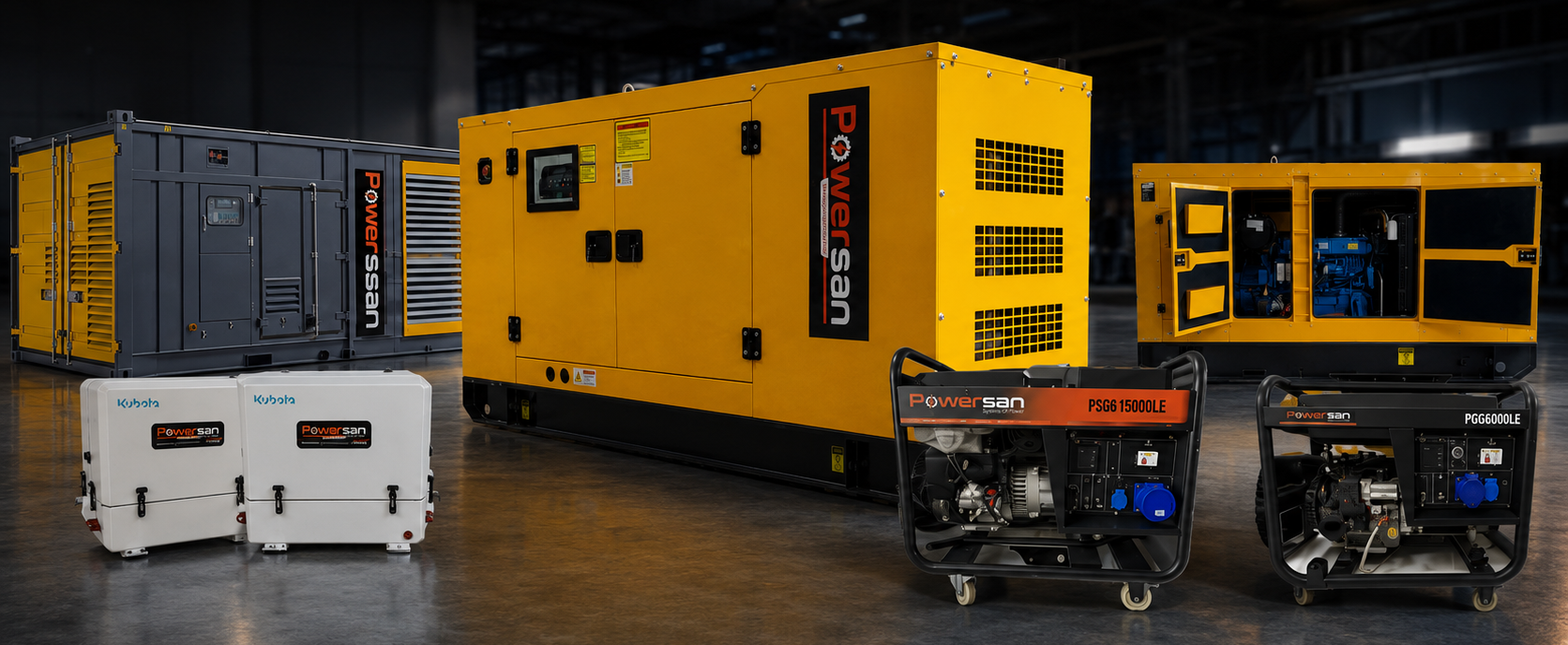
Generator rental is a practical solution for businesses and projects that require temporary or emergency power without the financial commitment of purchasing a generator set. It is commonly used during power outages, planned maintenance, temporary projects and events where a reliable source of electricity is required for a limited period.
Why Rent a Generator?
One of the main advantages of generator rental is cost control. Instead of investing in equipment that may only be required occasionally, businesses can rent a generator for the period in which it is actually needed. This can help avoid the long-term costs associated with ownership, including storage and ongoing maintenance.
Rental also provides flexibility. Generator sets are available in different power ratings and configurations, allowing users to select equipment that matches the requirements of a particular application. Depending on changing project conditions, a different generator capacity can also be selected for future requirements.
When Is Generator Rental Useful?
Temporary generator power can be particularly useful during unexpected utility outages, planned electrical maintenance or other situations where the normal power supply is unavailable. In these cases, a suitable generator can help maintain essential operations until the main power source is restored.
Generator rental is also widely used for events, festivals, concerts and temporary installations. These applications often create short-term power requirements that do not justify purchasing permanent generating equipment.
Technical Support and Service
Another benefit of generator rental is access to technical support. Depending on the rental service, maintenance, repair and other technical requirements may be handled as part of the service, reducing the operational responsibility placed on the customer.
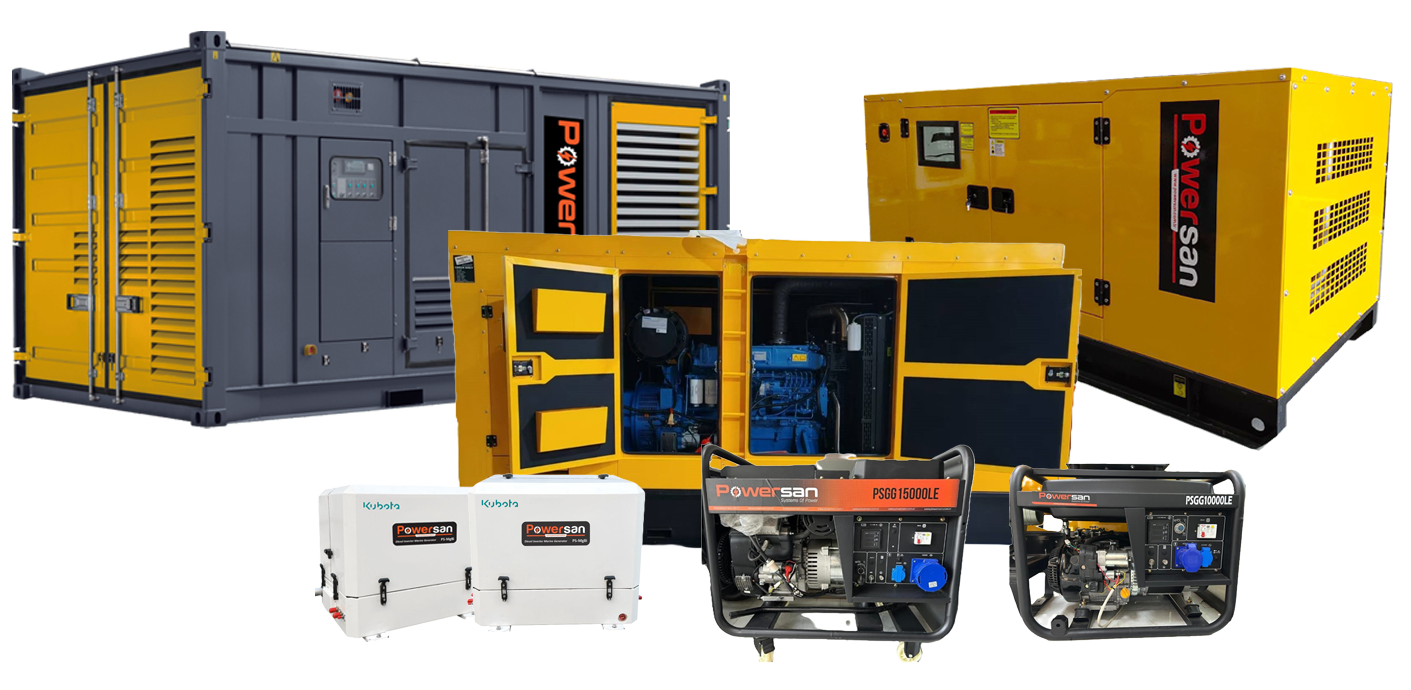
From small portable units to larger industrial generator sets, rental solutions provide a flexible way to meet temporary power requirements. Selecting the correct generator capacity and configuration remains important to ensure reliable operation and an appropriate match with the connected load.
```

